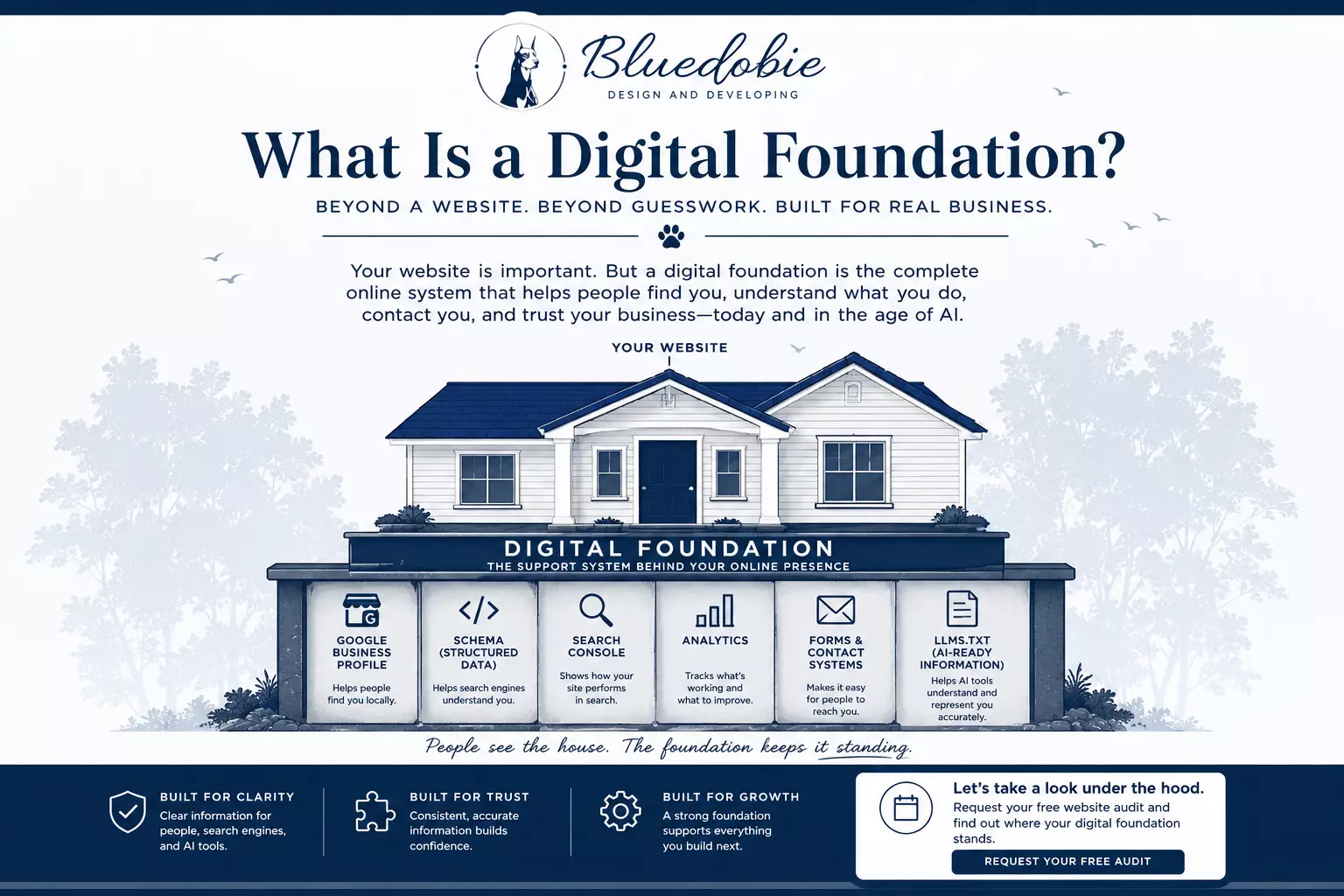
For a small business, a digital foundation is the set of practical online pieces that help people find you, understand what you do, contact you, and trust that your business is real.
It includes your website, but it also includes the quieter things that support it: search setup, metadata, forms, analytics, business profiles, structured data, and clear information for both humans and search engines.
A pretty website can still be fragile.
A digital foundation is what makes it useful.
Why a Website Alone Is Not Enough
A lot of small business owners think the job is done once the website is live.
That makes sense. A website is the visible part. It is the storefront window.
But the pieces behind that window matter too.
If Google does not understand your business, your website has to work harder than it should. If your contact form breaks, a potential client may simply move on. If your service area is unclear, people may not know whether to call. If your pages do not explain what you offer in plain language, both people and AI tools may describe your business poorly or skip over it entirely.
The problem is not always the website design.
Sometimes the problem is that the digital system around the website was never finished.
What a Digital Foundation Includes
A digital foundation is not one single tool. It is a practical setup that gives your business a stronger online base.
For Bluedobie Developing, that usually includes pieces like:
- A clear, mobile-friendly website
- Search-friendly page titles and descriptions
- A Google Business Profile review or setup
- Google Search Console
- Basic analytics
- Contact forms that work and reduce spam
- Clear service pages
- Local business information
- Structured data, also called schema
- An
llms.txt file for AI-readable business context
- Basic launch testing
- A follow-up check after the site has had time to settle
None of these pieces need to be flashy.
They need to be dependable.
The Goal Is Clarity
A good digital foundation answers basic questions clearly:
- Who are you?
- What do you do?
- Where do you work?
- Who do you help?
- How should someone contact you?
- What should they expect next?
Those questions sound simple, but many small business websites leave at least one of them fuzzy. Sometimes the phone number is easy to miss. Sometimes the service area is buried. Sometimes the homepage says “quality service” five different ways but never clearly says what the business actually does.
Clarity is not decoration.
Clarity is infrastructure.
Why This Matters More Now
Search is changing.
People still use Google, but they also ask AI assistants, map tools, voice search, social platforms, and recommendation engines to help them make decisions. Those tools need clear information to work with.
If your business information is scattered, outdated, or vague, those systems may not understand you well.
That does not mean every small business needs to chase every new technology. Most do not.
It means your business needs a clean, consistent base that can be understood by people, search engines, and AI tools without making them dig through a junk drawer.
What Structured Data Does
Structured data is code that helps search engines understand what a page is about.
For example, it can identify:
- Your business name
- Your location
- Your service area
- Your phone number
- Your services
- Your FAQ page
- Your website structure
Visitors usually do not see structured data, but search engines and other systems can read it.
Think of it as labeling the drawers in your digital filing cabinet. The cabinet may already hold the right information, but labels make it easier to find and trust.
What llms.txt Does
An llms.txt file is a plain text file that gives AI systems a clear summary of your business.
It is not a replacement for your website.
It is a helper file.
It can explain your business name, services, service area, key pages, and best summary in a format that is easy for AI tools to read. For small businesses, this is part of becoming easier to understand in a world where people increasingly ask AI tools for recommendations, explanations, and comparisons.
It does not guarantee visibility.
It improves clarity.
That is the point.
A Digital Foundation Should Respect Real Business Limits
Small businesses do not need bloated systems.
They need systems they can maintain.
A good digital foundation should not create more work than it solves. It should reduce confusion, protect important information, and make the next step easier.
That matters because most small businesses are not operating with a full marketing department. They are operating around appointments, invoices, family responsibilities, weather, staffing issues, health, repairs, customer calls, and the general chaos of real life.
A system that only works when the owner has perfect energy is not durable enough.
The foundation has to work on normal days.
And on the 50% capacity days.
How Bluedobie Approaches Digital Foundations
Bluedobie Developing builds digital foundations with practical small businesses in mind.
That means we look at the whole setup, not just the surface of the website.
We look for things like:
- Can people tell what you do quickly?
- Is your service area clear?
- Do your calls to action make sense?
- Are your forms working?
- Is your business information consistent?
- Can Google understand the site?
- Can AI tools summarize the business accurately?
- Are there privacy concerns, such as a home-based business address that should not be published?
- Is the setup manageable after launch?
The goal is not to make the internet complicated.
The goal is to make your business easier to find, easier to understand, and easier to contact.
Who Needs a Digital Foundation?
A digital foundation is especially useful for:
- Local service businesses
- Home-based businesses
- Small businesses with outdated websites
- Businesses that rely on Google searches or referrals
- Businesses that have changed services, locations, or contact details
- Owners who are tired of duct-taping tools together
- Businesses preparing for a new website launch
- Businesses that want AI tools to understand them more accurately
If your website exists but feels disconnected from the rest of your business, you probably do not just need a redesign.
You may need a foundation pass.
What This Is Not
A digital foundation is not a promise of instant rankings.
It is not a trick.
It is not stuffing keywords into every corner of the page and hoping Google gets impressed.
It is not adding technology just to say you added technology.
A digital foundation is a practical cleanup and setup process. It gives your business a more reliable online base so future marketing, content, search, and AI visibility have something solid to build on.
Start With a Website Audit
The easiest way to find out where your foundation stands is with a website audit.
Bluedobie’s free website audit looks at the practical pieces first: clarity, usability, search basics, page structure, and obvious friction points.
Sometimes the fix is small.
Sometimes the site needs a deeper cleanup.
Either way, the first step is seeing what is actually there.
Not guessing.
Not panicking.
Just looking at the system clearly.